Blog Water Quality Is the Quietest Risk on Your Mine Site — and the Loudest When It Fails

By Scott Yaworski / 23 Nov 2026 / Topics: Microsoft Fabric , Analytics , Intelligent edge , Operational efficiency
Key takeaways
- Water quality can seem less urgent than ore grade, equipment uptime, haul cycles, or labour in mining operations, but a production decision without water context can leave important questions unanswered.
- Better visibility into water quality can lead to better decision-making for treatment and processing teams, in terms of closure planning, and for surrounding communities too.
- The Insight OT Data Rescue accelerator integrates key operational sources and analytics to make water data useful while there is still time to investigate, decide, and act.
Ore grade. Equipment uptime. Haul cycles. Labour. These are the mine-performance conversations that command attention. Water quality can seem less urgent, but it connects processing, tailings, dust suppression, closure planning, and relationships with surrounding communities.
In other words, water quality is critical, but the data that assesses it may sit apart from the systems used to understand production. A water-quality signal without operational context can be difficult to interpret, while a production decision without water context can leave important questions unanswered.
From compliance reporting to operational intelligence
Consider a hypothetical change in pH, sulphate, or conductivity. On its own, the reading raises a question. Alongside rainfall, hydrological conditions, production activity, and verified laboratory results, it becomes a starting point for understanding what may have changed and what deserves attention.
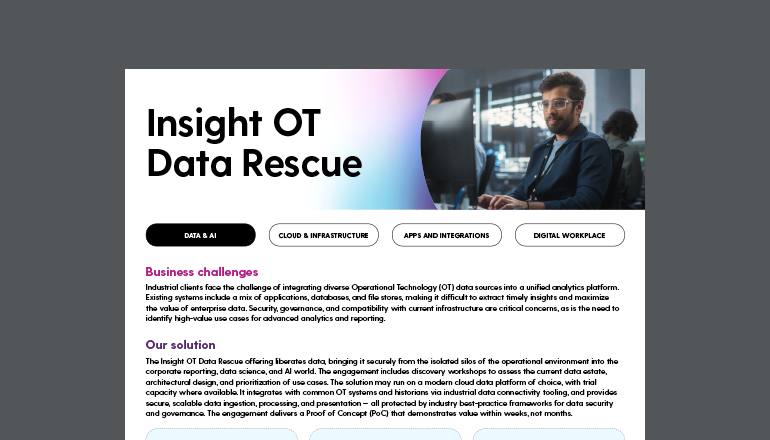
That is where the Insight OT Data Rescue accelerator offers a practical path forward. The engagement combines discovery workshops, architecture design, and prioritized use cases with a Proof of Concept (PoC) that integrates key operational sources and analytics. It can use Microsoft Fabric or another modern platform, with governance built into ingestion, processing, and presentation. It also makes water information useful while there is still time to investigate, decide, and act.
The value lies in better questions. Is a change associated with weather, a process adjustment or an instrument issue? Does it call for additional sampling, an inspection or a treatment response? Shared context places more focus on those conversations.
Better visibility leads to better decision-making.
For treatment teams, more timely and reliable information can support informed decisions about operating conditions and, with site-specific evaluation, create opportunities to investigate reagent or energy efficiencies.
For processing teams, examining water chemistry alongside metallurgical performance may reveal relationships worth investigating. For closure planning, a consistent history of verified measurements can strengthen the evidence used to assess conditions and future requirements.
There is a community dimension, too. Clear information supports transparency and more constructive dialogue about water. Trust depends on how organizations respond to concerns, acknowledge uncertainty, and follow through on commitments. The practical test is whether information changes a decision. If nobody owns the next step, a beautifully presented trend is still only a trend.
Monitoring is not the same as maintaining
A sensor can indicate that something needs attention. It cannot perform an inspection, calibrate itself reliably in every circumstance, verify a sample, or take responsibility for an intervention. Sensors complement laboratory testing, required compliance sampling, and environmental expertise; They never replace them.
This is why in this instance data takes priority over the AI conversation. Establish baselines. Understand provenance and quality. Decide who can access the information and who is accountable for acting on it. Make alerts actionable. Advanced analytics can then be considered against a specific question, rather than be asked to compensate for uncertain inputs.
Even sound monitoring practices can lose value when information remains trapped in separate operational systems. Teams should not wait for an entire digital transformation before exploring one well-defined water-management question.
A focused starting point establishes which data is needed, whether it can be accessed securely and what a useful answer would look like. The OT Data Rescue accelerator helps connect operational technologies such as Wonderware, OSI, Aveva, DeltaV, and OPC through Cogent DataHub, alongside tailored Power BI reports and real-time dashboards. For water management, the goal is to identify relevant, accessible sources, and demonstrate useful analysis.
This is just one of many potential use cases.
Ask yourself: What is your water doing right now, and how do you know? A useful answer requires more than a reading. It needs verifiable evidence, operational context, and someone responsible for the response. If the question is difficult to answer, let’s connect and talk about how Insight can help you find a way to improve your organization’s water management.
About the author:

Scott Yaworski
Data & AI Lead, Insight Canada
Scott Yaworski is the manager of data and AI at Insight Canada, where he helps organizations maximize the value of modern data, analytics, and AI platforms. With expertise in solution strategy, technical leadership, and client engagement, he works closely with clients to align technology investments with business goals. Scott collaborates with consulting, architecture, and delivery teams to design and implement cloud, data, and AI solutions that accelerate digital initiatives, improve decision-making, and deliver measurable business outcomes.