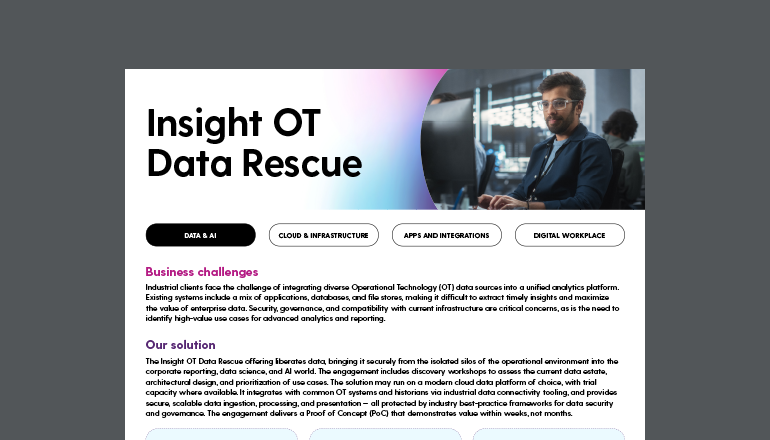
Blog From Siloed OT Data to Smarter Mining Decisions
By Scott Yaworski / 3 Jul 2026 / Topics: Analytics , Data protection , Sustainability

Key takeaways
- Mining companies have valuable OT data, but it is often trapped across historians, plant systems, databases, and files — slowing reporting and enterprise-wide decision-making.
- Insight’s OT Data Rescue securely connects industrial data sources to Microsoft Fabric, enabling real-time dashboards, trusted analytics, and an AI-ready data foundation.
- By reducing manual reporting and improving visibility into key metrics, OT Data Rescue empowers mining teams to make faster, smarter operational decisions.
Walk into almost any control room and you’ll see the same paradox. The plant is generating an enormous amount of operational data every shift and, somewhere nearby, someone is still copying tonnage figures onto a sheet of paper to hand off to the next crew.
I see this constantly with my mining clients. Mining companies aren’t short on data; the problem is where it lives — which is spread across historians, plant systems, databases, and file stores that weren’t built to support fast, enterprise-wide decisions.
This leaves operations leaders dealing with slow reporting, fragmented visibility, and mounting pressure to modernize without taking on new security or governance risk along the way.
Insight’s OT Data Rescue: Why now
In mining, even a small amount of unplanned downtime can carry significant operational and financial consequences. At the same time, many organizations are sitting on years of valuable operational data that remains underutilized.
We built Insight’s OT Data Rescue solution to bridge that gap. In plain terms, we securely move Operational Technology (OT) data out of isolated environments and into a modern analytics foundation where it can actually be used for reporting, data science, and AI.
What makes our approach different?
We start with the business outcome, not the technology. Every engagement begins with discovery workshops where we assess the current data estate, pinpoint the use cases that will deliver the most value, and design a practical path forward. From there we connect industrial sources like AVEVA and DeltaV through Cogent DataHub into Microsoft Fabric, where the data can feed Power BI and real-time dashboards.
The outcome isn’t just better connectivity. It’s a secure, scalable foundation that moves an organization from reactive reporting to timely, trusted operational insights.
Benefits
For executives, the value shows up fast in day-to-day operations. We’re removing manual report creation by automatically slicing timestamped data into shifts, which cuts paper-based handoffs along with the time and transcription risk that come with them. That same foundation supports tonnage tracking and trend analysis, giving teams a clear view of shift-over-shift performance and helping them catch production issues earlier before they grow into bigger problems.
But the impact goes well beyond reporting.
One of our mining clients is using runtime visibility on conveyors and crushers to expose downtime and utilization gaps they could never quantify before. Real-time KQL dashboards in Fabric with alerts for anomalous or missing data help their teams respond faster and trust the underlying numbers more — increasing production awareness, strengthening equipment visibility, and informing maintenance and process decisions.
Just as important, OT Data Rescue creates a platform for whatever comes next. For that same client, the foundation we put in place is already positioned to support future water tracking and sustainability reporting. Plus, it gives the business a centralized OT data layer that future analytics, machine learning, and new reporting can build on — without reworking the whole environment each time.
In an industry where disconnected data still slows modernization and ESG expectations keep rising, that kind of reusable foundation isn’t just a technical win. It’s a strategic one. This, at a high level, is the value of OT Data Rescue: turning trapped operational data into faster decisions, better visibility, and a stronger platform for digital mining.
How to get started
The best part about getting started with Insight’s OT Data Rescue solution is, instead of launching a massive transformation program, you can begin with the data you already have. We’ll use it to improve your performance today, while getting you ready for the next wave of analytics and AI.
Keep this in mind: The organizations that gain the greatest advantage from AI won’t necessarily be the ones with the most sophisticated models. They’ll be the ones that can reliably access, trust, and operationalize their data.
That’s the challenge Insight’s OT Data Rescue was built to solve.
Fortify your data foundation. Scale from isolated wins to enterprise impact with Insight.
About the Authors:

Scott Yaworski
Data & AI Lead, Insight Canada
Scott Yaworski is the manager of data and AI at Insight Canada, where he helps organizations maximize the value of modern data, analytics, and AI platforms. With expertise in solution strategy, technical leadership, and client engagement, he works closely with clients to align technology investments with business goals. Scott collaborates with consulting, architecture, and delivery teams to design and implement cloud, data, and AI solutions that accelerate digital initiatives, improve decision-making, and deliver measurable business outcomes.